Research library
Chemistry and synthesis: completion history
All area pages | Area definition | Scoring rubric
Created November 7, 2026. The three earlier snapshots are retrospective judgment-based estimates, not scores recorded at the time. The current assessment is unchanged. Historical confidence is very low; current confidence is low. Zero can indicate an evidence gap rather than absent capability.
Chart layout updated November 8, 2026: one graph with four dated lines. Scores and assessment dates are unchanged. Overlapping lines indicate equal values; point labels show November 7, 2026. The table below contains every date's exact values.
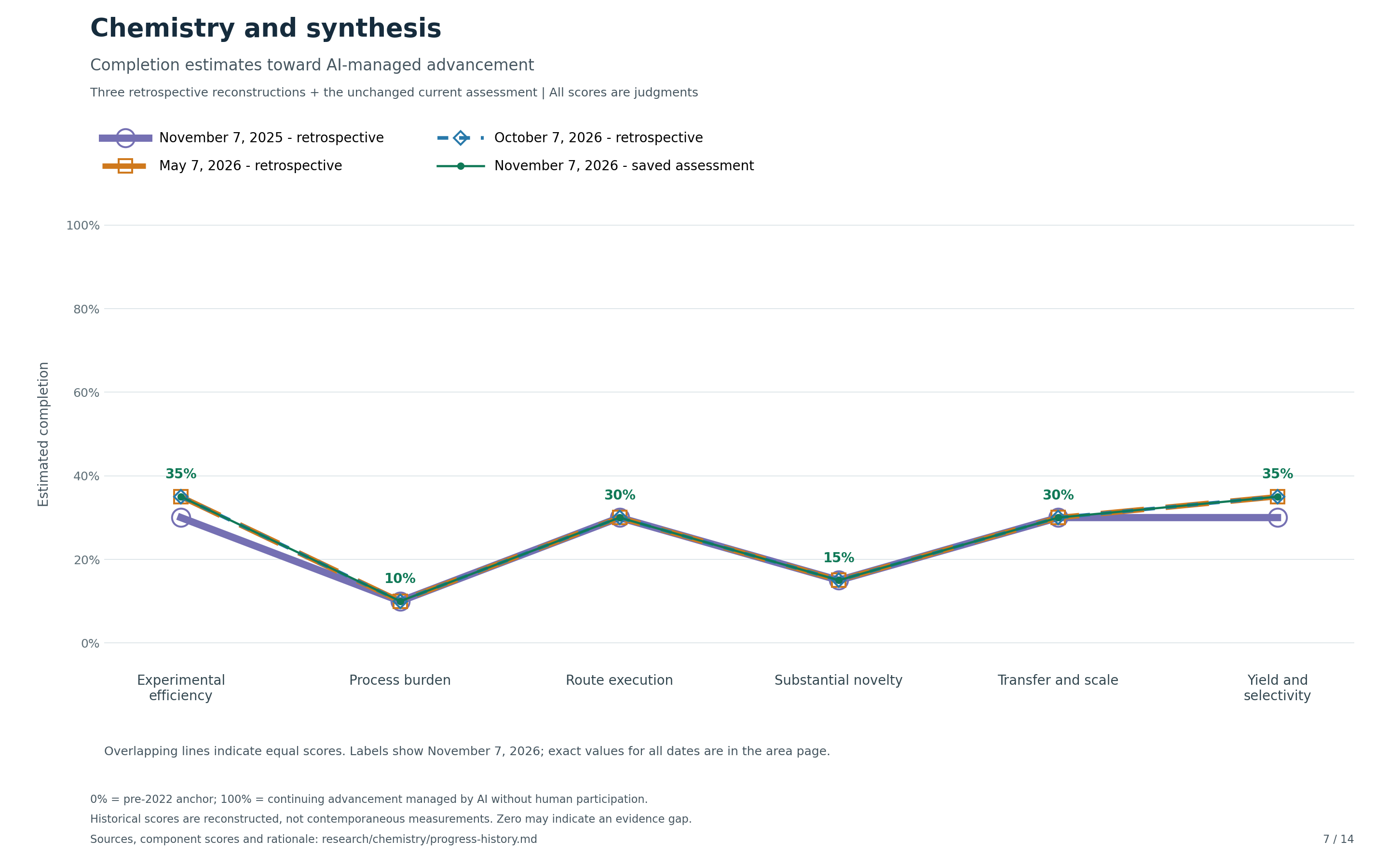
Scalable graph | Combined 14-page report
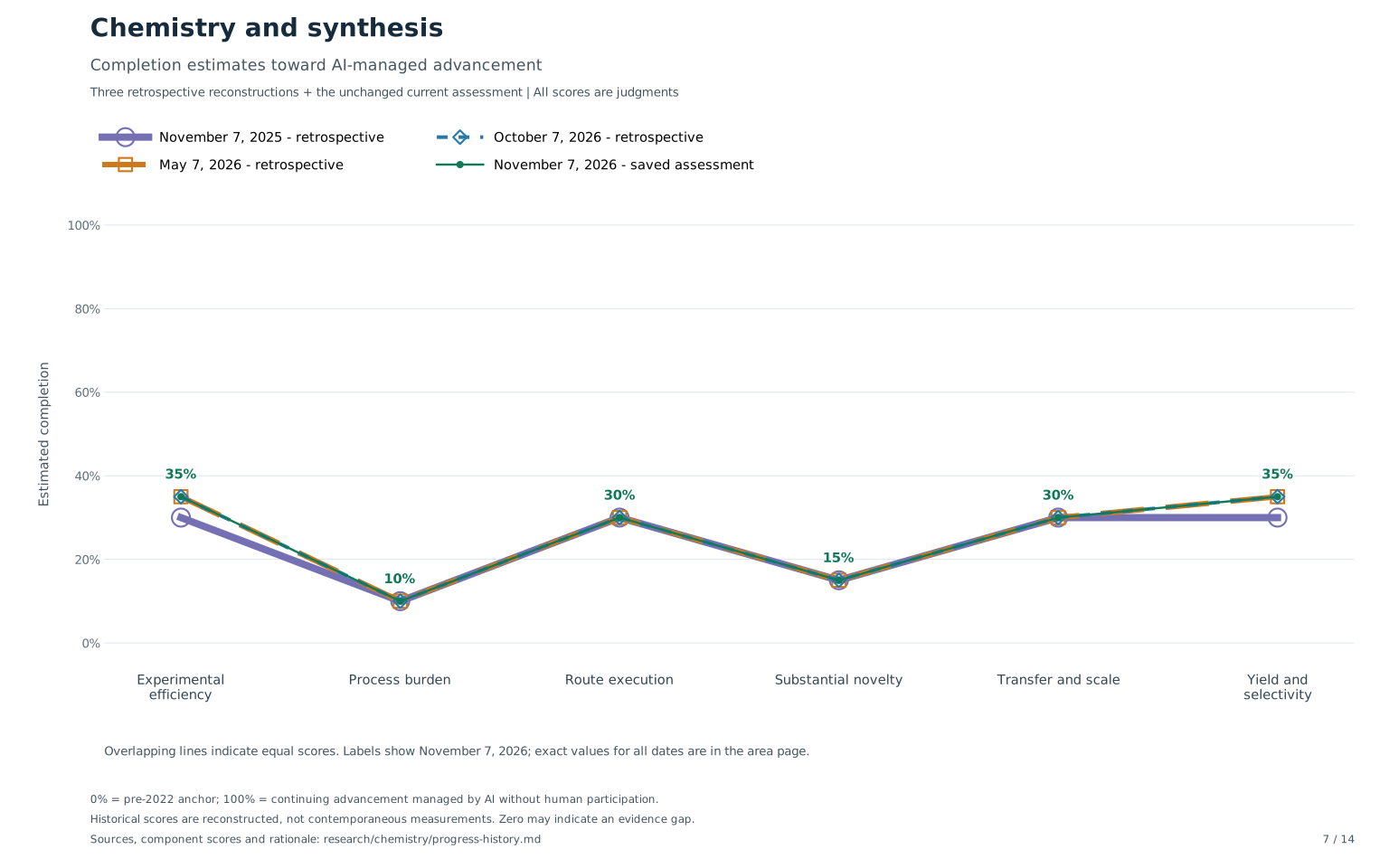
Percentage estimates
| Measurable outcome | Nov 7, 2025 (reconstructed) | May 7, 2026 (reconstructed) | Oct 7, 2026 (reconstructed) | Nov 7, 2026 (saved) |
|---|---|---|---|---|
| Experimental efficiency | 30% | 35% | 35% | 35% |
| Process burden | 10% | 10% | 10% | 10% |
| Route execution | 30% | 30% | 30% | 30% |
| Substantial novelty | 15% | 15% | 15% | 15% |
| Transfer and scale | 30% | 30% | 30% | 30% |
| Yield and selectivity | 30% | 35% | 35% | 35% |
Reconstruction notes and component scores
Components below are execution / breadth / agenda-setting / validation / sustained autonomous improvement, each out of 20. Their sum gives the percentage. The component values are judgments, not published statistics. Source links document evidence available by the cutoff, not the numerical estimate itself. The source section lists availability dates and version caveats. No area-wide average is calculated.
Experimental efficiency
Earlier flow optimization earns bounded efficiency credit. The April 2026 campaign record makes evaluation more inspectable; full economics remain missing.
| Assessment date | Component points | Evidence used |
|---|---|---|
| 2025-11-07 (reconstructed) | 10 / 5 / 5 / 5 / 5 = 30% | robo24 |
| 2026-05-07 (reconstructed) | 10 / 5 / 5 / 10 / 5 = 35% | robopaper |
| 2026-10-07 (reconstructed) | 10 / 5 / 5 / 10 / 5 = 35% | robopaper |
| 2026-11-07 (saved) | 10 / 5 / 5 / 10 / 5 = 35% | Original score and evidence |
Process burden
Automation and affordability are enabling evidence only. No verified waste or energy reduction per qualified kilogram supports a higher score.
| Assessment date | Component points | Evidence used |
|---|---|---|
| 2025-11-07 (reconstructed) | 5 / 5 / 0 / 0 / 0 = 10% | robo24 |
| 2026-05-07 (reconstructed) | 5 / 5 / 0 / 0 / 0 = 10% | robopaper |
| 2026-10-07 (reconstructed) | 5 / 5 / 0 / 0 / 0 = 10% | robopaper |
| 2026-11-07 (saved) | 5 / 5 / 0 / 0 / 0 = 10% | Original score and evidence |
Route execution
Selected executed reactions predate every cutoff. The full diverse-target success denominator remains absent.
| Assessment date | Component points | Evidence used |
|---|---|---|
| 2025-11-07 (reconstructed) | 10 / 5 / 5 / 5 / 5 = 30% | cosci |
| 2026-05-07 (reconstructed) | 10 / 5 / 5 / 5 / 5 = 30% | cosci |
| 2026-10-07 (reconstructed) | 10 / 5 / 5 / 5 / 5 = 30% | cosci |
| 2026-11-07 (saved) | 10 / 5 / 5 / 5 / 5 = 30% | Original score and evidence |
Substantial novelty
Known-reaction automation is a precursor rather than new transformation discovery; no historical novelty-rate increase is inferred.
| Assessment date | Component points | Evidence used |
|---|---|---|
| 2025-11-07 (reconstructed) | 5 / 5 / 0 / 5 / 0 = 15% | cosci |
| 2026-05-07 (reconstructed) | 5 / 5 / 0 / 5 / 0 = 15% | cosci |
| 2026-10-07 (reconstructed) | 5 / 5 / 0 / 5 / 0 = 15% | cosci |
| 2026-11-07 (saved) | 5 / 5 / 0 / 5 / 0 = 15% | Original score and evidence |
Transfer and scale
Both earlier flow scale-up and the 2026 case study remain laboratory demonstrations. More examples do not automatically cross a rubric threshold.
| Assessment date | Component points | Evidence used |
|---|---|---|
| 2025-11-07 (reconstructed) | 10 / 5 / 5 / 5 / 5 = 30% | robo24 |
| 2026-05-07 (reconstructed) | 10 / 5 / 5 / 5 / 5 = 30% | robopaper |
| 2026-10-07 (reconstructed) | 10 / 5 / 5 / 5 / 5 = 30% | robopaper |
| 2026-11-07 (saved) | 10 / 5 / 5 / 5 / 5 = 30% | Original score and evidence |
Yield and selectivity
Earlier automated reaction optimization supplies a baseline. Explicit instrument-versus-isolated outcome reporting in 2026 adds validation evidence, not universal reaction autonomy.
| Assessment date | Component points | Evidence used |
|---|---|---|
| 2025-11-07 (reconstructed) | 10 / 5 / 5 / 5 / 5 = 30% | robo24 |
| 2026-05-07 (reconstructed) | 10 / 5 / 5 / 10 / 5 = 35% | robopaper |
| 2026-10-07 (reconstructed) | 10 / 5 / 5 / 10 / 5 = 35% | robopaper |
| 2026-11-07 (saved) | 10 / 5 / 5 / 10 / 5 = 35% | Original score and evidence |
Dated sources
All sources accessed November 7, 2026. Dates below are publication or conservative availability dates, as noted.
cosci | 2023-12-20 - Coscientist, Nature. Computer-directed chemical experiments using established reaction capabilities.
robo24 | 2024-01-25 - RoboChem university research report. Flow reaction optimization and scale-up; laboratory scope.
robopaper | 2026-04-13 - RoboChem-Flex, Nature Synthesis. Multi-case reaction optimization with isolated scale-up evidence.
Future updates
Keep these reconstructions separate from subsequently recorded observations. Append new dated assessments with changed component scores and source evidence; do not silently replace historical reasoning. The shared historical-method notes describe how these snapshots were made.