Research library
Mathematics: completion history
All area pages | Area definition | Scoring rubric
Created November 7, 2026. The three earlier snapshots are retrospective judgment-based estimates, not scores recorded at the time. The current assessment is unchanged. Historical confidence is very low; current confidence is low. Zero can indicate an evidence gap rather than absent capability.
Chart layout updated November 8, 2026: one graph with four dated lines. Scores and assessment dates are unchanged. Overlapping lines indicate equal values; point labels show November 7, 2026. The table below contains every date's exact values.
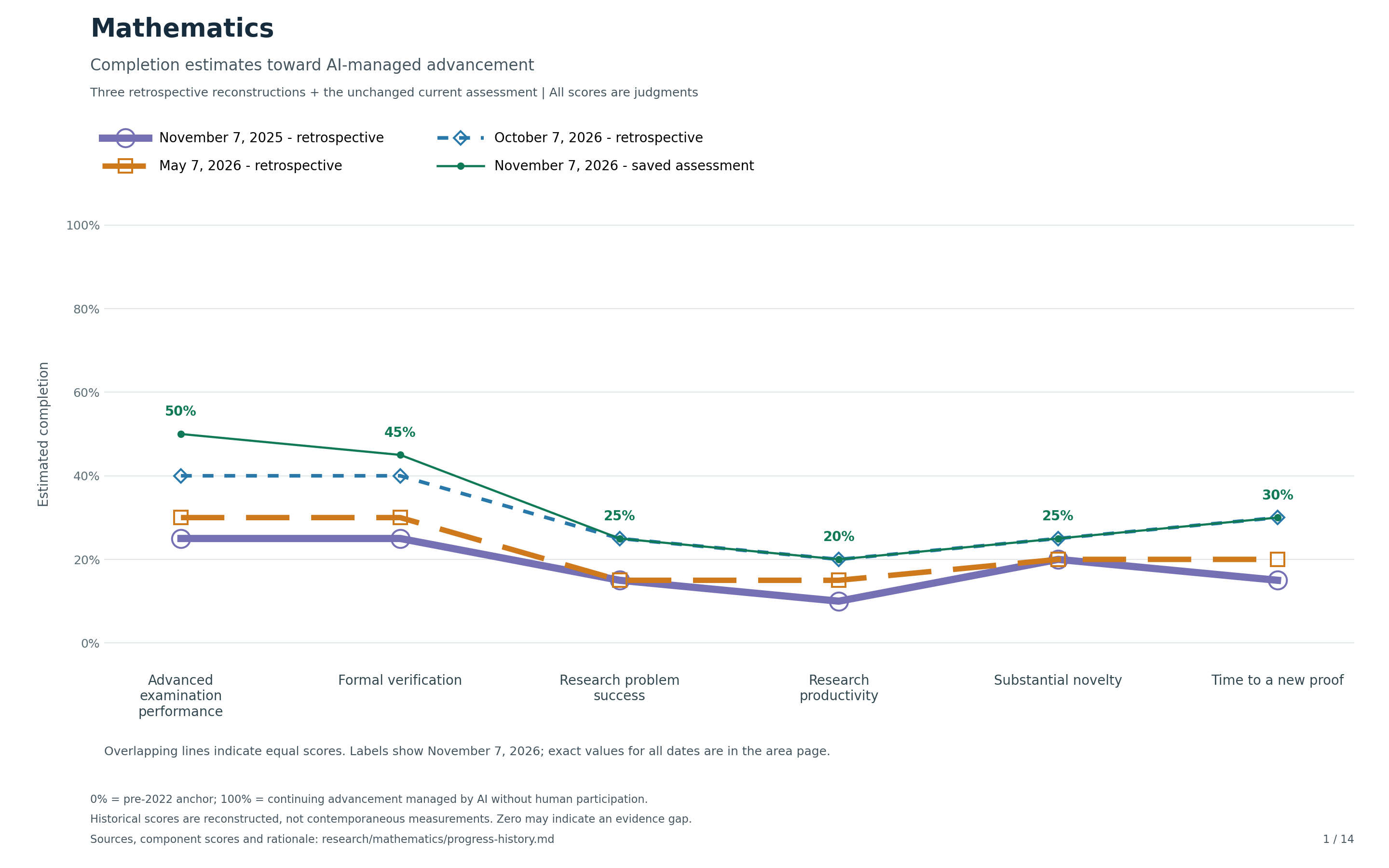
Scalable graph | Combined 14-page report
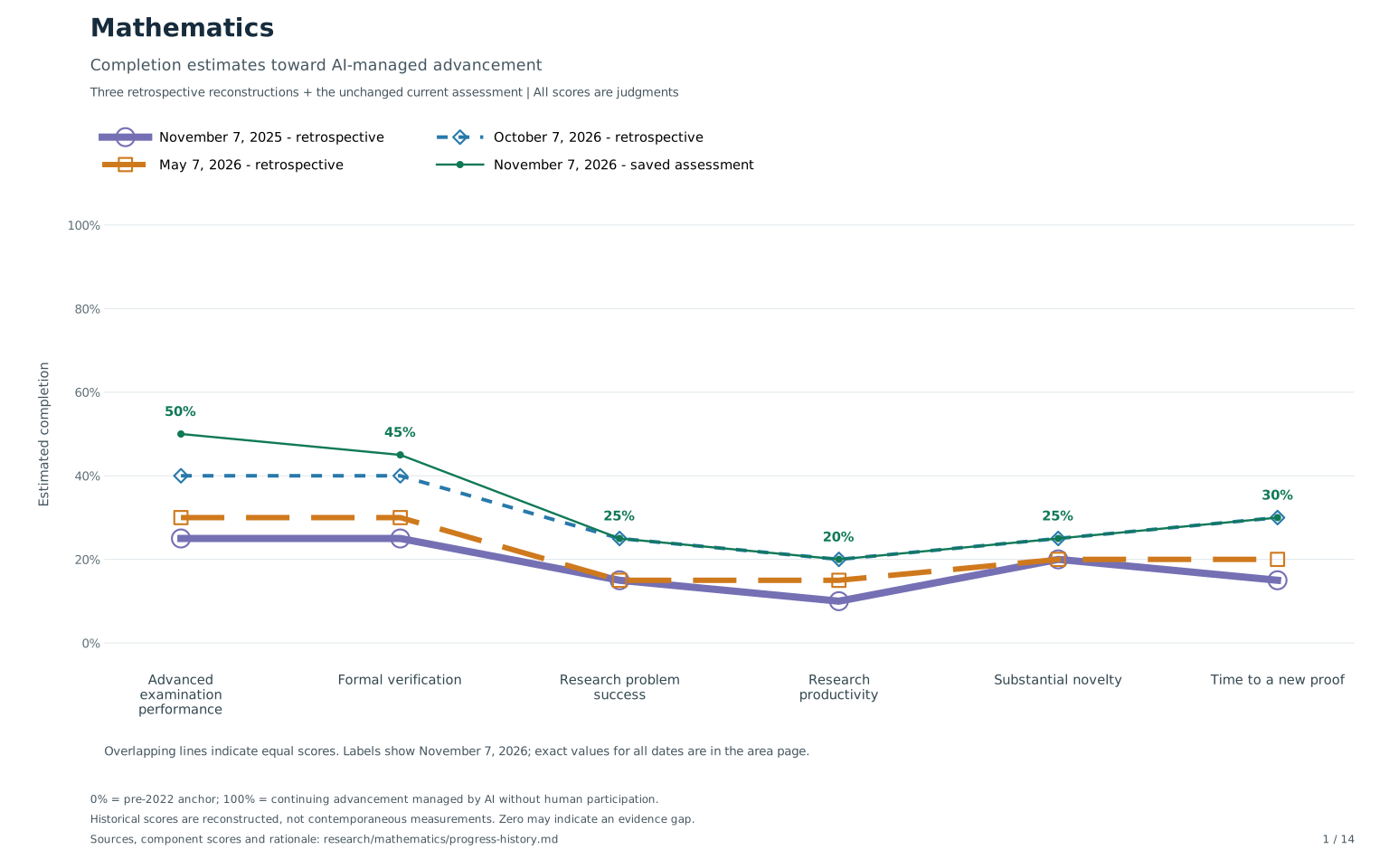
Percentage estimates
| Measurable outcome | Nov 7, 2025 (reconstructed) | May 7, 2026 (reconstructed) | Oct 7, 2026 (reconstructed) | Nov 7, 2026 (saved) |
|---|---|---|---|---|
| Advanced examination performance | 25% | 30% | 40% | 50% |
| Formal verification | 25% | 30% | 40% | 45% |
| Research problem success | 15% | 15% | 25% | 25% |
| Research productivity | 10% | 15% | 20% | 20% |
| Substantial novelty | 20% | 20% | 25% | 25% |
| Time to a new proof | 15% | 20% | 30% | 30% |
Reconstruction notes and component scores
Components below are execution / breadth / agenda-setting / validation / sustained autonomous improvement, each out of 20. Their sum gives the percentage. The component values are judgments, not published statistics. Source links document evidence available by the cutoff, not the numerical estimate itself. The source section lists availability dates and version caveats. No area-wide average is calculated.
Advanced examination performance
Contest proofs support only a limited 2025 proxy. March 2026 supplies graduate-level formal tasks; September formalization adds execution breadth. The October 29 saturated benchmark is excluded from October 7.
| Assessment date | Component points | Evidence used |
|---|---|---|
| 2025-11-07 (reconstructed) | 10 / 5 / 0 / 10 / 0 = 25% | imo24 |
| 2026-05-07 (reconstructed) | 10 / 10 / 0 / 10 / 0 = 30% | formal26 |
| 2026-10-07 (reconstructed) | 15 / 10 / 5 / 10 / 0 = 40% | formal26, fermat26 |
| 2026-11-07 (saved) | 15 / 15 / 5 / 10 / 5 = 50% | Original score and evidence |
Formal verification
Early formal proof checking earns bounded validation credit. Larger September artifacts increase execution/breadth; the saved current score adds limited sustained-work credit. None establishes audited universal coverage.
| Assessment date | Component points | Evidence used |
|---|---|---|
| 2025-11-07 (reconstructed) | 10 / 5 / 0 / 10 / 0 = 25% | imo24 |
| 2026-05-07 (reconstructed) | 15 / 5 / 0 / 10 / 0 = 30% | formal26 |
| 2026-10-07 (reconstructed) | 15 / 10 / 5 / 10 / 0 = 40% | fermat26, mathrelease |
| 2026-11-07 (saved) | 15 / 10 / 5 / 10 / 5 = 45% | Original score and evidence |
Research problem success
Early constructions provide research evidence without a comparable all-problem success rate. The June open-problem campaign supports a higher execution judgment by October; do not backdate the October 29 ledger.
| Assessment date | Component points | Evidence used |
|---|---|---|
| 2025-11-07 (reconstructed) | 5 / 5 / 0 / 5 / 0 = 15% | math25 |
| 2026-05-07 (reconstructed) | 5 / 5 / 0 / 5 / 0 = 15% | math25 |
| 2026-10-07 (reconstructed) | 10 / 5 / 0 / 5 / 5 = 25% | math25, nexus |
| 2026-11-07 (saved) | 10 / 5 / 0 / 5 / 5 = 25% | Original score and evidence |
Research productivity
No full cost or human-hour denominator exists. March benchmark economics add a bounded validation proxy; October's larger candidate collection supports execution credit but not an accepted-discovery rate.
| Assessment date | Component points | Evidence used |
|---|---|---|
| 2025-11-07 (reconstructed) | 5 / 5 / 0 / 0 / 0 = 10% | math25 |
| 2026-05-07 (reconstructed) | 5 / 5 / 0 / 5 / 0 = 15% | formal26 |
| 2026-10-07 (reconstructed) | 10 / 5 / 0 / 5 / 0 = 20% | formal26, mathrelease |
| 2026-11-07 (saved) | 10 / 5 / 0 / 5 / 0 = 20% | Original score and evidence |
Substantial novelty
The 2025 constructions support limited novelty evidence. Later open-problem work supports continued research activity, while autonomous prior-art and significance judgments remain missing.
| Assessment date | Component points | Evidence used |
|---|---|---|
| 2025-11-07 (reconstructed) | 10 / 5 / 0 / 5 / 0 = 20% | math25 |
| 2026-05-07 (reconstructed) | 10 / 5 / 0 / 5 / 0 = 20% | math25 |
| 2026-10-07 (reconstructed) | 10 / 5 / 0 / 5 / 5 = 25% | nexus, mathrelease |
| 2026-11-07 (saved) | 10 / 5 / 0 / 5 / 5 = 25% | Original score and evidence |
Time to a new proof
Older work does not establish end-to-end timing. March provides measured proof-task latency and September large-formalization timings; neither measures fully accepted new-proof completion.
| Assessment date | Component points | Evidence used |
|---|---|---|
| 2025-11-07 (reconstructed) | 5 / 5 / 0 / 5 / 0 = 15% | math25 |
| 2026-05-07 (reconstructed) | 10 / 5 / 0 / 5 / 0 = 20% | formal26 |
| 2026-10-07 (reconstructed) | 15 / 5 / 0 / 5 / 5 = 30% | fermat26, mathrelease |
| 2026-11-07 (saved) | 15 / 5 / 0 / 5 / 5 = 30% | Original score and evidence |
Dated sources
All sources accessed November 7, 2026. Dates below are publication or conservative availability dates, as noted.
imo24 | 2024-07-25 - AlphaProof and AlphaGeometry IMO demonstration. Known-answer contest proof tasks, with manual formalization; not graduate exams or autonomous discovery.
math25 | 2025-11-03 - Mathematical exploration and discovery at scale, v1. Mathematical constructions and improved bounds; not universal independent research or full Lean coverage.
formal26 | 2026-03-27 - FormalProofBench v1. Supplied Lean statements and a fixed tool budget; keep separate from later revisions.
nexus | 2026-06-08 - AlphaProof Nexus v2. Open-problem search; specialist verification and full campaign resource accounting remain essential.
fermat26 | 2026-09-04 - Fermat formalization report. Large known-theorem formalization with human guidance; not a newly discovered theorem.
mathrelease | 2026-10-06 - OpenAI mathematics release. Candidate research collection; not a complete independently accepted discovery count.
Future updates
Keep these reconstructions separate from subsequently recorded observations. Append new dated assessments with changed component scores and source evidence; do not silently replace historical reasoning. The shared historical-method notes describe how these snapshots were made.