Research library
AI research: completion history
All area pages | Area definition | Scoring rubric
Created November 7, 2026. The three earlier snapshots are retrospective judgment-based estimates, not scores recorded at the time. The current assessment is unchanged. Historical confidence is very low; current confidence is low. Zero can indicate an evidence gap rather than absent capability.
Chart layout updated November 8, 2026: one graph with four dated lines. Scores and assessment dates are unchanged. Overlapping lines indicate equal values; point labels show November 7, 2026. The table below contains every date's exact values.
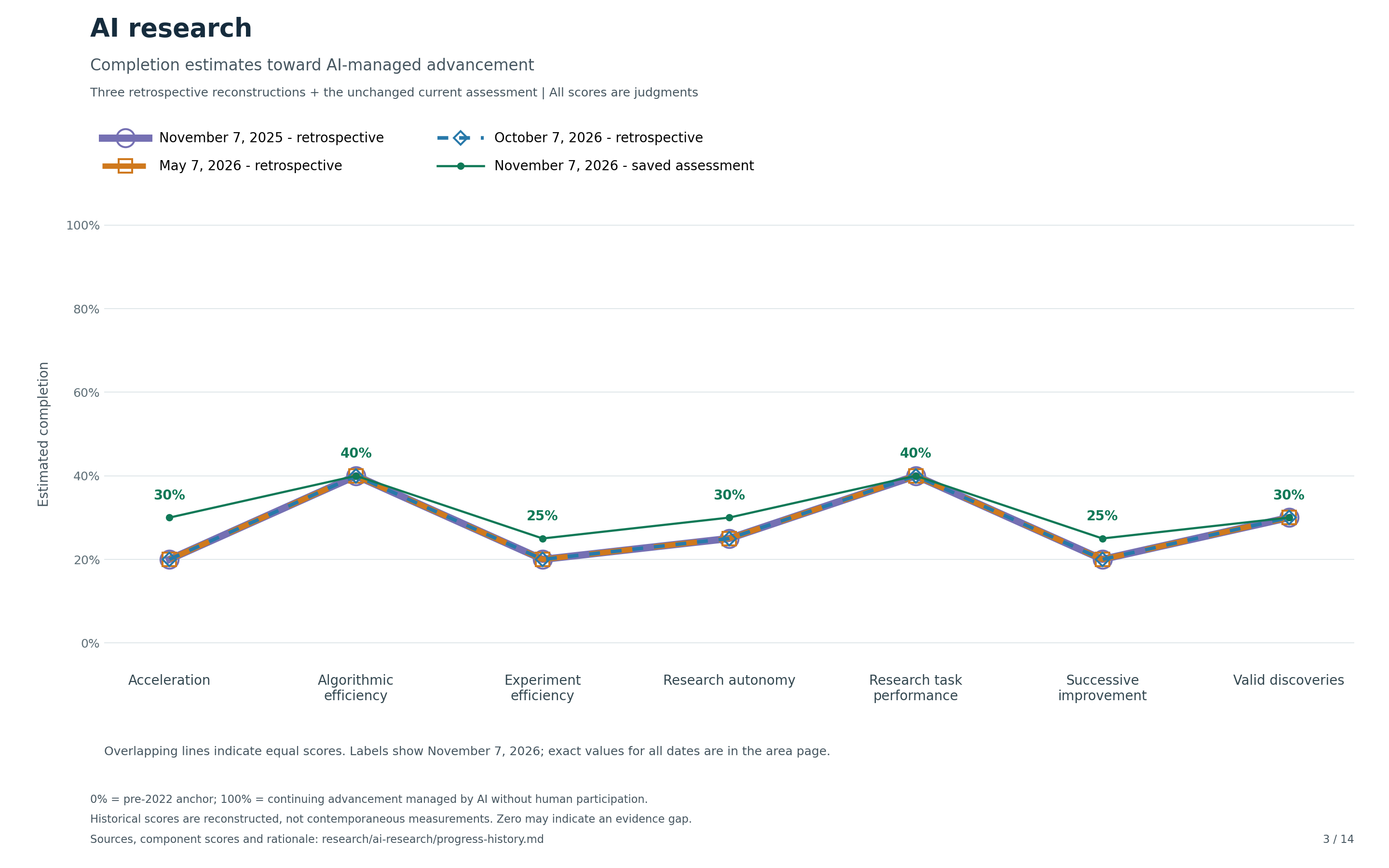
Scalable graph | Combined 14-page report
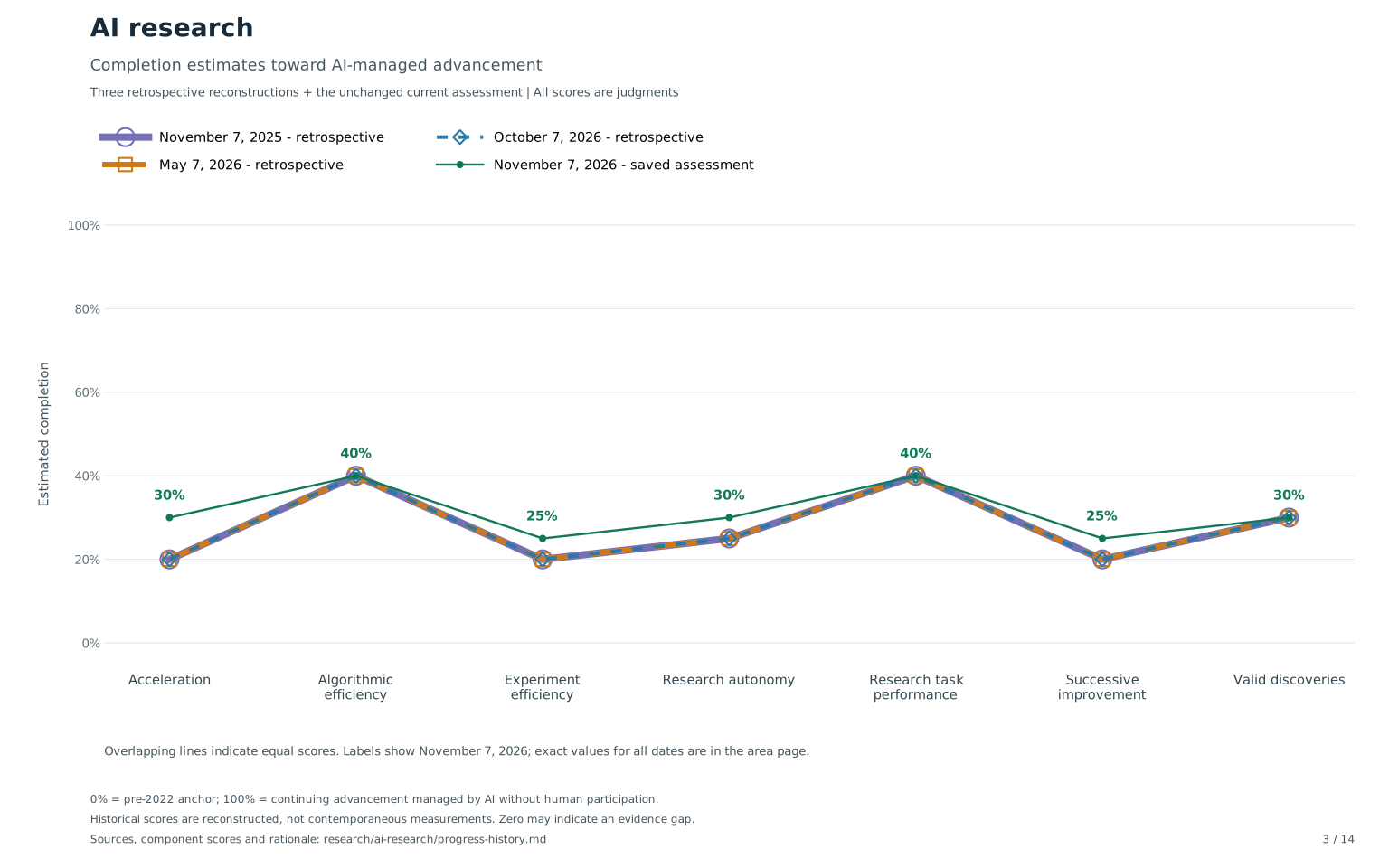
Percentage estimates
| Measurable outcome | Nov 7, 2025 (reconstructed) | May 7, 2026 (reconstructed) | Oct 7, 2026 (reconstructed) | Nov 7, 2026 (saved) |
|---|---|---|---|---|
| Acceleration | 20% | 20% | 20% | 30% |
| Algorithmic efficiency | 40% | 40% | 40% | 40% |
| Experiment efficiency | 20% | 20% | 20% | 25% |
| Research autonomy | 25% | 25% | 25% | 30% |
| Research task performance | 40% | 40% | 40% | 40% |
| Successive improvement | 20% | 20% | 20% | 25% |
| Valid discoveries | 30% | 30% | 30% | 30% |
Reconstruction notes and component scores
Components below are execution / breadth / agenda-setting / validation / sustained autonomous improvement, each out of 20. Their sum gives the percentage. The component values are judgments, not published statistics. Source links document evidence available by the cutoff, not the numerical estimate itself. The source section lists availability dates and version caveats. No area-wide average is calculated.
Acceleration
Narrow feedback supports partial credit at all past cutoffs. The organizational acceleration assessment was published November 5, so its added execution/agenda evidence appears only in the current score.
| Assessment date | Component points | Evidence used |
|---|---|---|
| 2025-11-07 (reconstructed) | 5 / 5 / 0 / 5 / 5 = 20% | evolve25, rebench |
| 2026-05-07 (reconstructed) | 5 / 5 / 0 / 5 / 5 = 20% | evolve25, rebench |
| 2026-10-07 (reconstructed) | 5 / 5 / 0 / 5 / 5 = 20% | evolve25, rebench |
| 2026-11-07 (saved) | 10 / 5 / 5 / 5 / 5 = 30% | Original score and evidence |
Algorithmic efficiency
The optimization evidence already existed in May 2025. Carry the same bounded judgment rather than invent gains from the later December restatement.
| Assessment date | Component points | Evidence used |
|---|---|---|
| 2025-11-07 (reconstructed) | 15 / 5 / 5 / 10 / 5 = 40% | evolve25 |
| 2026-05-07 (reconstructed) | 15 / 5 / 5 / 10 / 5 = 40% | evolve25 |
| 2026-10-07 (reconstructed) | 15 / 5 / 5 / 10 / 5 = 40% | evolve25 |
| 2026-11-07 (saved) | 15 / 5 / 5 / 10 / 5 = 40% | Original score and evidence |
Experiment efficiency
Earlier bounded search lacks full campaign efficiency accounting. November's organizational workflow assessment supports only a small additional planning judgment.
| Assessment date | Component points | Evidence used |
|---|---|---|
| 2025-11-07 (reconstructed) | 5 / 5 / 0 / 5 / 5 = 20% | evolve25, rebench |
| 2026-05-07 (reconstructed) | 5 / 5 / 0 / 5 / 5 = 20% | evolve25, rebench |
| 2026-10-07 (reconstructed) | 5 / 5 / 0 / 5 / 5 = 20% | evolve25, rebench |
| 2026-11-07 (saved) | 5 / 5 / 5 / 5 / 5 = 25% | Original score and evidence |
Research autonomy
Bounded agent research is documented before every historical cutoff. Human-defined tasks constrain agenda credit; the November assessment supports the current limited agenda component.
| Assessment date | Component points | Evidence used |
|---|---|---|
| 2025-11-07 (reconstructed) | 10 / 5 / 0 / 5 / 5 = 25% | rebench, evolve25 |
| 2026-05-07 (reconstructed) | 10 / 5 / 0 / 5 / 5 = 25% | rebench, evolve25 |
| 2026-10-07 (reconstructed) | 10 / 5 / 0 / 5 / 5 = 25% | rebench, evolve25 |
| 2026-11-07 (saved) | 10 / 5 / 5 / 5 / 5 = 30% | Original score and evidence |
Research task performance
The same dated bounded-task evidence supports all snapshots. No comparable new task series is established here, so the score is held flat.
| Assessment date | Component points | Evidence used |
|---|---|---|
| 2025-11-07 (reconstructed) | 10 / 10 / 5 / 10 / 5 = 40% | rebench |
| 2026-05-07 (reconstructed) | 10 / 10 / 5 / 10 / 5 = 40% | rebench |
| 2026-10-07 (reconstructed) | 10 / 10 / 5 / 10 / 5 = 40% | rebench |
| 2026-11-07 (saved) | 10 / 10 / 5 / 10 / 5 = 40% | Original score and evidence |
Successive improvement
Narrow feedback into model training predates 2025's cutoff, but does not establish a causal multi-generation series. November's assessment modestly strengthens planning evidence.
| Assessment date | Component points | Evidence used |
|---|---|---|
| 2025-11-07 (reconstructed) | 5 / 5 / 0 / 5 / 5 = 20% | evolve25 |
| 2026-05-07 (reconstructed) | 5 / 5 / 0 / 5 / 5 = 20% | evolve25 |
| 2026-10-07 (reconstructed) | 5 / 5 / 0 / 5 / 5 = 20% | evolve25 |
| 2026-11-07 (saved) | 5 / 5 / 5 / 5 / 5 = 25% | Original score and evidence |
Valid discoveries
Accepted optimizations predate every snapshot. Missing independent multi-seed replication prevents an inferred upward trajectory.
| Assessment date | Component points | Evidence used |
|---|---|---|
| 2025-11-07 (reconstructed) | 10 / 5 / 5 / 5 / 5 = 30% | evolve25 |
| 2026-05-07 (reconstructed) | 10 / 5 / 5 / 5 / 5 = 30% | evolve25 |
| 2026-10-07 (reconstructed) | 10 / 5 / 5 / 5 / 5 = 30% | evolve25 |
| 2026-11-07 (saved) | 10 / 5 / 5 / 5 / 5 = 30% | Original score and evidence |
Dated sources
All sources accessed November 7, 2026. Dates below are publication or conservative availability dates, as noted.
evolve25 | 2025-05-14 - AlphaEvolve announcement. Evaluated code optimization and narrow feedback into AI training; human-defined evaluators.
rebench | 2025-05-27 - RE-Bench research paper. Research-engineering evaluation; bounded tasks and fixed budgets, not a self-directed laboratory.
Future updates
Keep these reconstructions separate from subsequently recorded observations. Append new dated assessments with changed component scores and source evidence; do not silently replace historical reasoning. The shared historical-method notes describe how these snapshots were made.